
The periodic table arranges all 118 known elements in order of increasing atomic number, in 18 vertical groups and 7 horizontal periods, so that elements with similar properties fall in the same column. Hydrogen sits at number 1 and oganesson at 118.
Tap any box in the interactive table below to see its atomic mass, electronic configuration, shells, valency and Hindi name. This page then explains how to read the chart, what the colours mean, the main trends you need for exams, and some tricks to learn the first 20 and 30 elements.
Quick facts
Total elements
118 (atomic numbers 1 to 118)Groups and periods
18 groups (columns), 7 periods (rows)Arranged by
Increasing atomic number (modern periodic law)Blocks
s, p, d and f, named after the subshell being filledLightest element
Hydrogen (H), atomic number 1, mass 1.008 uMost electronegative
Fluorine (F), 3.98 on the Pauling scaleNewest names
Nihonium (113), moscovium (115), tennessine (117), oganesson (118)Liquids at room temperature
Mercury (Hg) and bromine (Br)
The full periodic table
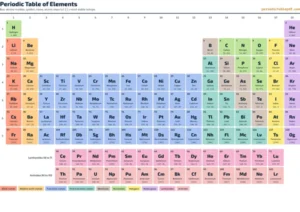
Here is the complete chart of the full periodic table elements, from hydrogen to oganesson. The two rows printed below the main body are the lanthanides and actinides. They really belong inside periods 6 and 7, but placing them inside would make the chart too wide for a page or a phone screen.
- Alkali metals
- Alkaline earth metals
- Transition metals
- Post-transition metals
- Metalloids
- Nonmetals
- Halogens
- Noble gases
- Lanthanides
- Actinides
Want this on paper? The periodic table PDF page has colour, black and white, blank practice and configuration versions in A4 size, and a chart with Hindi names is in periodic table in Hindi.
How to read one box of the periodic table
Every element gets one small box, and each box carries the same four facts in the same places. Once you can read one box, you can read the whole chart.
- Atomic number (Z), usually in the top corner. It is the number of protons in the nucleus, and in a neutral atom it also equals the number of electrons. No two elements share a Z.
- Symbol, the big letters in the middle: one capital letter, or a capital followed by a small letter (Co is cobalt, but CO is carbon monoxide, a compound).
- Name of the element, written under the symbol.
- Atomic mass in u (unified atomic mass units), the average mass of the atoms as found in nature. A value in square brackets, like [294], is used for an element too short lived to have a natural average; it shows the mass number of its most stable known isotope.
Reading the box for iron
The box shows 26 at the top, Fe in the centre, Iron below it and 55.845 at the bottom.
So an iron atom has 26 protons and, when neutral, 26 electrons. Its average atomic mass is about 55.85 u.
Answer: Z = 26, symbol Fe, mass 55.845 u.
The tool above adds more: the electronic configuration, electrons per shell, group, period, block and valency. For a full list of masses, see atomic mass of elements.
Groups and periods: columns and rows
A group is a vertical column. There are 18, numbered 1 to 18 from left to right. Elements in one group have the same number of valence electrons (outer shell electrons), so they react in similar ways. Sodium and potassium, both in group 1, each have one outer electron and both react vigorously with water.
A period is a horizontal row. There are 7. The period number tells you how many shells an atom has. Sodium is in period 3, so its electrons sit in three shells: 2, 8, 1.
| Period | Elements in it | Range of Z |
|---|---|---|
| 1 | 2 | 1 to 2 |
| 2 | 8 | 3 to 10 |
| 3 | 8 | 11 to 18 |
| 4 | 18 | 19 to 36 |
| 5 | 18 | 37 to 54 |
| 6 | 32 | 55 to 86 |
| 7 | 32 | 87 to 118 |
Some groups have family names you will hear often: group 1 is the alkali metals, group 2 the alkaline earth metals, group 17 the halogens and group 18 the noble gases. The modern periodic table page explains why the period lengths come out as 2, 8, 8, 18, 18, 32, 32.
The four blocks: s, p, d and f
The chart also splits into four blocks, named after the subshell that receives the last electron.
- s block: groups 1 and 2, plus helium. Mostly soft, reactive metals, along with hydrogen and helium.
- p block: groups 13 to 18. Holds all the nonmetals except hydrogen and helium, plus the metalloids and some metals.
- d block: groups 3 to 12, the transition metals such as iron, copper, silver and gold.
- f block: the two separate rows at the bottom, the lanthanides and actinides (inner transition elements).
The s and p block elements together are called representative elements. Read more on s and p block elements and d and f block elements. The order in which subshells fill is on the electronic configuration page.
Element types and their colours
Colour on a chemistry periodic table is not decoration. Each colour marks a type of element, and the legend under the chart says which colour is which. Our interactive chart uses ten types, and you can filter by any of them.
| Type | Where | Examples |
|---|---|---|
| Alkali metals | Group 1 (not H) | Li, Na, K |
| Alkaline earth metals | Group 2 | Mg, Ca |
| Transition metals | Groups 3 to 12 | Fe, Cu, Zn |
| Post-transition metals | p block, lower left | Al, Sn, Pb |
| Metalloids | Along the staircase line | B, Si, As |
| Nonmetals | p block, upper right, plus H | C, N, O |
| Halogens | Group 17 | F, Cl, I |
| Noble gases | Group 18 | He, Ne, Ar |
| Lanthanides | First bottom row | Ce, Nd, Gd |
| Actinides | Second bottom row | Th, U, Pu |
Metalloids in the periodic table
A zigzag staircase runs down the p block from boron to polonium. Metals lie to its left and nonmetals to its right. The elements touching the line show mixed behaviour and are called metalloids: boron, silicon, germanium, arsenic, antimony, tellurium and polonium in our data. Silicon is the best known, since it is a semiconductor used in chips and solar cells.
Periodic trends: size, electronegativity and metallic character
Properties change in a regular way as you move along the chart. Three trends come up again and again in exams.
Atomic size
Across a period, from left to right, atoms get smaller. Each step adds one proton, so the nuclear charge rises, but the new electron goes into the same shell. The stronger pull draws the shell inward. Down a group, atoms get bigger, because each period adds a whole new shell further out.
Electronegativity
Electronegativity is how strongly an atom pulls a shared pair of electrons in a bond towards itself. It rises across a period and falls down a group, for the same reasons as size: a small atom with a strong nuclear pull grabs electrons well. Fluorine, at the top right (ignoring noble gases), has the highest value, 3.98. Caesium and francium near the bottom left have the lowest.
Metallic character
Metals tend to lose electrons. That gets easier as atoms get bigger and the outer electron sits further from the nucleus. So metallic character falls across a period and rises down a group. In period 3, sodium is a soft metal, silicon is a metalloid and chlorine is a nonmetal gas.
Quick rule: size and metallic character grow towards the bottom left; electronegativity and ionisation energy grow towards the top right.
How many elements are in the periodic table
There are 118 elements in the periodic table today, and all seven periods are full. The total elements in periodic table counts is the same in every current textbook, including NCERT. Of these, about 94 occur in nature (some only in traces) and the rest have been made in laboratories and reactors.
The four newest names fill the end of period 7: nihonium (Nh, 113), moscovium (Mc, 115), tennessine (Ts, 117) and oganesson (Og, 118). IUPAC, the international body for chemical names, approved them after the discoveries were confirmed. Scientists are now trying to make elements 119 and 120, which would start an eighth period.
Counted by type in our data: 40 transition metals, 14 lanthanides, 14 actinides, 11 post-transition metals, 7 metalloids, 7 other nonmetals, 6 halogens, 7 noble gases, 6 alkali metals and 6 alkaline earth metals. Around 90 of the 118 are metals.
Radioactive elements
Radioactive elements have nuclei that are unstable and break down on their own, giving out radiation. In our data 37 elements are marked radioactive.
- Every element from polonium (84) onward is radioactive. Bismuth (83) is the last one treated as stable.
- Two lighter ones break the pattern: technetium (Tc, 43) and promethium (Pm, 61) have no stable isotope at all.
- Well known examples: uranium and plutonium (nuclear fuel), radium (studied by early radiation scientists), radon (a gas that can collect in basements) and thorium.
Elements past uranium (92) are called transuranium elements. None has a stable isotope, which is why their masses appear in square brackets, and the heaviest of them last only seconds or less.
Tricks to remember the first 20 and 30 elements
Most school tests ask for the first 20 elements, and many ask for 30 elements with symbols, mass and valency. Learn them in groups of ten with a silly sentence, where each word starts with the symbol.
Elements 1 to 10
H, He, Li, Be, B, C, N, O, F, Ne
"Hari Helped Little Bela Bring Carrots, Nuts, Oranges, Figs, Nectarines."
Answer: hydrogen, helium, lithium, beryllium, boron, carbon, nitrogen, oxygen, fluorine, neon.
Elements 11 to 20
Na, Mg, Al, Si, P, S, Cl, Ar, K, Ca
"Naina's Magic Alarm Sings Pleasant Songs; Clever Arjun Keeps Calm."
Answer: sodium, magnesium, aluminium, silicon, phosphorus, sulphur, chlorine, argon, potassium, calcium.
Elements 21 to 30
Sc, Ti, V, Cr, Mn, Fe, Co, Ni, Cu, Zn
"Scooters, Tyres, Vans, Cars, Many Ferries, Coaches, Nice Cute Zeppelins."
Answer: scandium, titanium, vanadium, chromium, manganese, iron, cobalt, nickel, copper, zinc.
Then write them out from memory once a day for a week, filling a blank chart. The elements 1 to 30 page lists the 20 elements of periodic table and the next ten with mass and valency, and a blank grid to fill is on the PDF page.
Periodic table practice problems
Try these without looking, then use the chart above to check.
- An element has electrons arranged 2, 8, 2. Give its group, period and name.
- Which is bigger, a sodium atom or a chlorine atom? Why?
- Name the halogen in period 4.
- Which block does an element with Z = 29 belong to?
- Arrange N, O and F in increasing order of electronegativity.
Answers: (1) Group 2, period 3, magnesium. (2) Sodium, because chlorine has 6 more protons pulling on the same three shells. (3) Bromine. (4) d block; Z = 29 is copper. (5) N < O < F.
For questions on combining capacity, see valency of elements; for writing formulas of compounds, see chemical formulas and chemistry formulas.
Where the periodic table comes in your syllabus
The topic appears in more than one class, so it pays to learn it properly once.
- Class 9: atomic number, mass number, symbols, and the electron arrangement and valency of the lighter elements.
- Class 10: the chapter on periodic classification of elements in older NCERT books; it covers early attempts, Mendeleev and the modern table.
- Class 11: chapter 3 on periodicity, which explains trends such as atomic radius and the energy needed to remove an electron.
- Class 12 and entrance tests: block-wise chemistry, such as the d and f block chapter, builds directly on the periodic table NCERT layout.
For the history, from triads to octaves to Mendeleev's gaps, read the Mendeleev periodic table story. A list of every name and symbol is on periodic table with names.
Download the PDF
Questions students ask
How many elements are there in the periodic table?
There are 118 elements. Hydrogen is number 1 and oganesson is number 118. All seven periods are now complete.
Who made the periodic table?
Dmitri Mendeleev published the first widely used table, arranged by atomic mass. Henry Moseley later showed that atomic number is the true basis, which gave us the modern table used today.
What is the difference between a group and a period?
A group is a vertical column (18 in all) and holds elements with the same number of valence electrons. A period is a horizontal row (7 in all) and holds elements with the same number of shells.
Which is the heaviest element?
Oganesson, atomic number 118, has the largest atomic number; its mass is listed as [294] u. Among elements found in nature in useful amounts, uranium (92) is the heaviest.
Why are the lanthanides and actinides shown at the bottom?
They belong in periods 6 and 7 between groups 3 and 4. Putting 14 extra boxes into each of those rows would make the chart very wide, so they are printed as two separate rows below.
Which elements are liquid at room temperature?
Only mercury (a metal) and bromine (a nonmetal). Gallium and caesium melt just above room temperature, so they can turn liquid on a hot day.
Is hydrogen a metal?
No. Hydrogen is a nonmetal gas. It is placed in group 1 because it has one electron in its only shell, like the alkali metals, but its properties are quite different.